What is data federation
Data federation is a data management approach that provides unified, real-time access to data across multiple systems without physically moving or copying it into a central location. Instead of relying on traditional ETL (Extract, Transform, Load) processes, federation creates a virtual layer that lets users query and analyze distributed data as if it were stored in a single database.
By abstracting the complexity of different data models, formats, and storage technologies, data federation enables organizations to work across on-premises databases, cloud platforms, graph systems, APIs, and large-scale data environments through a consistent access layer. This approach is especially valuable in enterprise environments where data resides in many systems and needs to be accessed and combined in real time.
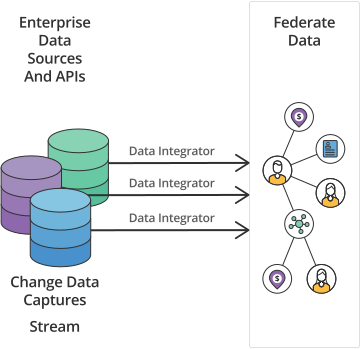
Data federation aggregates data from multiple sources without physically moving or copying data.
Data federation with Tom Sawyer Perspectives
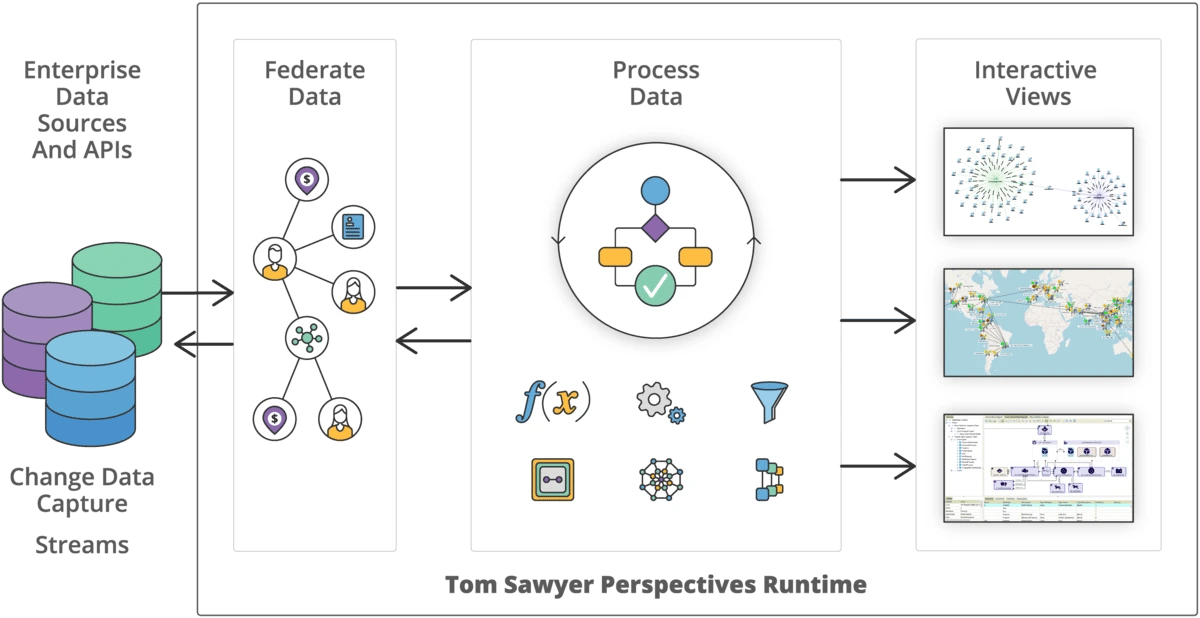
Our mature, data-agnostic graph platform, Tom Sawyer Perspectives, includes data federation capabilities that combine data residing in different data sources and with different data structures providing enterprises with real-time access to a unified view of their data.
The process of data federation involves connecting to data sources using provided integrators, extracting the schema to understand the structure of the data, and binding the data source and the schema. This procedure is essential for achieving the flexibility and efficiency that data federation enables.
Benefits of data federation
Modern enterprises struggle to manage their data stores efficiently and cost-effectively, and in many cases must continue to maintain legacy systems that use older data storage technology. The problem is compounded by the need for businesses to understand and utilize the data contained in these various systems to their competitive advantage.
Uncovering the important data in these data silos requires purpose-built techniques and tools to enable efficient and improved decision-making.
Data federation has become indispensable for organizations seeking to harness the power of their collective data assets. The benefits of data federation extend far beyond data consolidation, touching every aspect of an organization's operations and strategic decision-making. Here's why data federation is crucial for organizations navigating the complexities of the modern data-driven world of fast-growing data and data silos:
Informed decision-making
Having a consolidated view of data from different systems provides a single source of truth for accurate decision-making.
This comprehensive insight enables businesses to make more informed choices, driving strategic initiatives and operational improvements.
New insights exposed
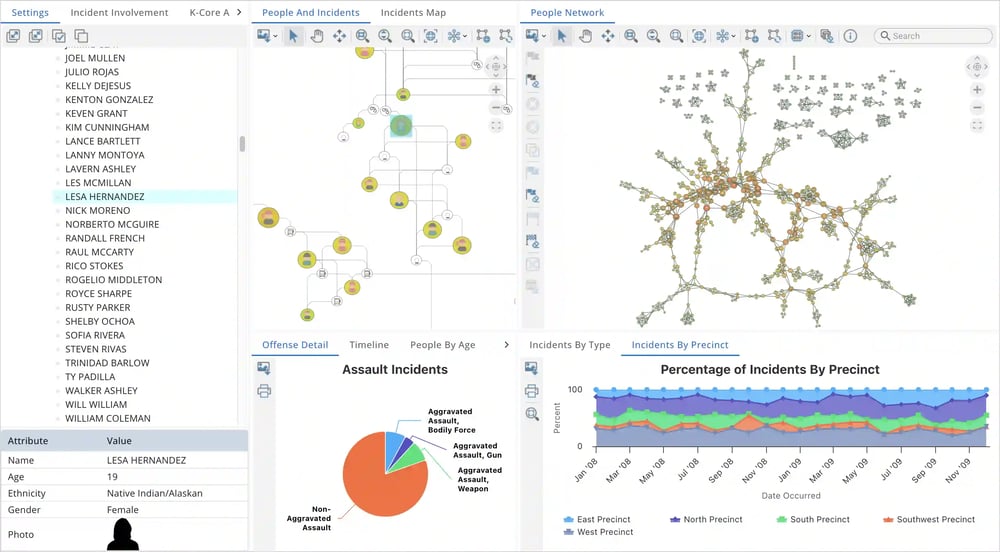
With federated data, you can apply specialized visualization and analysis techniques to expose interesting and previously unseen results.
This approach provides a holistic view across the entire enterprise for a more accurate and enhanced view.

Increased productivity
Data consumers have a single source of truth to consult, enabling them to make mission critical decisions quickly and accurately.
This accessibility significantly boosts productivity, allowing users to focus on analysis rather than data collection.
Improved data agility
Eliminating latency concerns and the need for data migration or synchronization, data can be accessed and queried in real-time.
This improvement in data agility and flexibility is crucial for organizations that need to respond rapidly to changing market conditions or internal demands.

Cost- and time-savings
Data federation reduces the dependency on IT teams to develop custom data integrations or move data around, leading to significant cost- and time-savings.
Organizations can allocate these resources to more strategic initiatives, enhancing overall efficiency and competitiveness.
Eliminate data redundancy
Unlike traditional data integration methods that often require moving or copying data to a central data lake or data warehouse, data federation allows data to remain in its source systems.
This approach minimizes redundancy, reduces storage costs, and simplifies data management.
Real-time data access
Data federation facilitates instant access to the latest data across the enterprise, enabling real-time analytics and timely decision-making.
It also offers enhanced responsiveness so organizations can quickly respond to internal and external developments, gaining a competitive edge.

Flexibility and scalability
Data federation offers exceptional flexibility and scalability, accommodating the evolving data landscape of an organization without significant restructuring or investment.
It seamlessly integrates new data sources and scales to handle increasing data volumes and complexity.

Enhanced data quality and governance
By centralizing access to data through a virtual layer, data federation facilitates better data quality management and governance practices.
It provides tools for monitoring, cleaning, and securing data across the organization, ensuring compliance with standards and regulations.
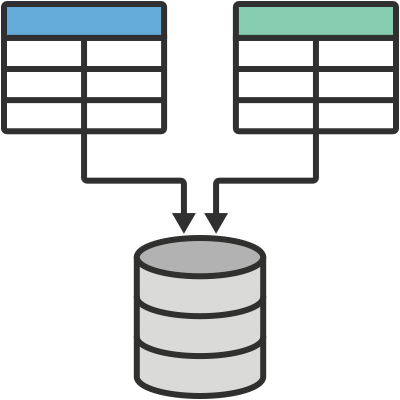
Relational databases
For organizations relying on structured data stored in SQL databases, Tom Sawyer Perspectives facilitates seamless integration by mapping table schemas into a unified virtual schema. This process allows users to query and manipulate data across multiple relational databases as if they were interacting with a single database.
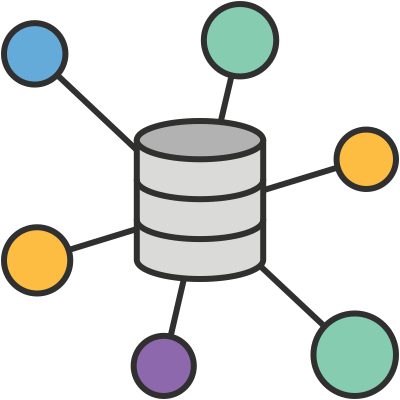
Graph databases
In cases where data relationships are as crucial as the data itself, such as Neo4j, Amazon Neptune, or Kuzu, Tom Sawyer Perspectives can virtualize these connections. By doing so, it offers a straightforward way to incorporate complex, relationship-driven insights into the federated data model without the need for extensive custom coding or transformation efforts.
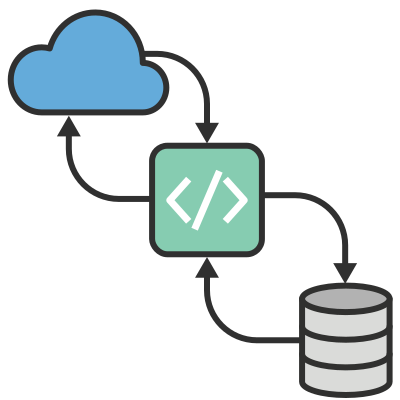
RESTful APIs
For data that is accessed via APIs, such as web services or cloud-based platforms, Tom Sawyer Perspectives can abstract the API layer. This enables direct queries and integrations into the federated model, making external data sources as accessible as internal databases.
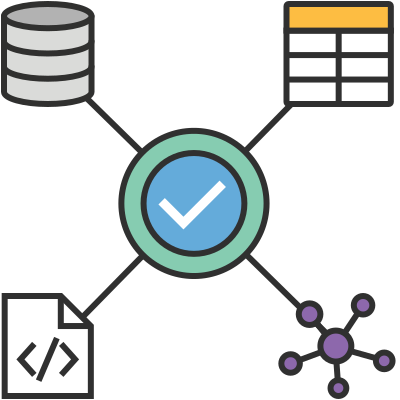
Broad data source compatibility
Tom Sawyer Perspectives is designed to be data agnostic, supporting a wide range of data sources beyond those mentioned. This includes, but is not limited to, Microsoft Excel, MongoDB, JSON files, RDF sources, and SQL JDBC-compliant databases. This versatility ensures that organizations can leverage the full spectrum of their data assets, regardless of where or how the data is stored.
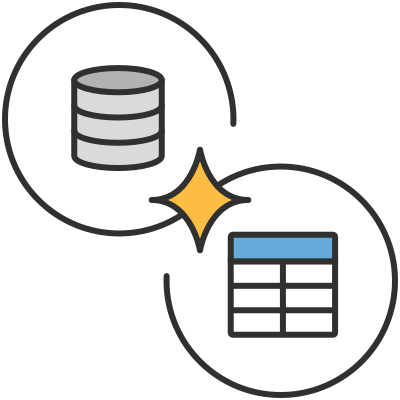
Streamlined integration process
The integration process with Tom Sawyer Perspectives involves connecting to the data sources using provided integrators, extracting the schema to understand the data structure, and then binding the data source with the schema. This method reduces the complexity and time required for integrating disparate data sources, enabling more agile data management and analysis practices.
Data federation versus data integration
Data federation and data integration aim to provide a cohesive view of data from multiple sources. With Tom Sawyer Perspectives, they go hand in hand and you get the best of both worlds.
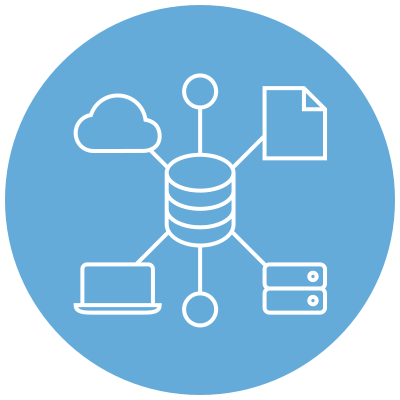
Data Federation
Data federation with Tom Sawyer Perspectives employs a virtual approach, leaving the data in its original sources and using software to aggregate multiple data sources at the same time and bind data from those multiple data sources into a single Tom Sawyer model. This method offers several advantages, including reduced data redundancy, minimized storage costs, and the ability to aggregate, present and query data in real-time or near-real-time.
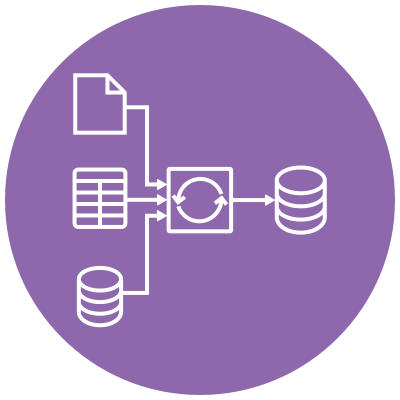
Data Integration
Data integration with Tom Sawyer Perspectives involves utilizing purpose-built connectors to connect to a data source, extract the schema, bind data from that data source to the Tom Sawyer model, and commit changes back to the data source. This eliminates the need for a physical repository, such as a data warehouse or data lake, which can be resource-intensive, requiring significant effort in data cleaning, transformation, storage management, and cost.