Designed for enterprise data architects
Enterprises face fragmented sources, legacy systems, and real-time demands. Tom Sawyer Data Streams supports a range of high-impact scenarios for data architects and AI platform engineers, from migration and continuous sync to validating generative AI results and integrating agentic results into a single-source-of-truth database.
Discover how Tom Sawyer Data Streams addresses common challenges with repeatable patterns and proven tooling.

One-Time Data ETL
ETL legacy relational models to a governed, query-ready knowledge graph. Introspect the source schema, design visual flows to rename, merge or split tables, convert properties into edges, and execute once to materialize the analytics-ready knowledge graph without expensive data migrations.

Continuous Sync / Change Data Capture (CDC) to Graph
Keep operational systems and streams in lockstep with an always-current knowledge graph. Ingest Kafka topics and database changes, apply SpEL transformations and filters, and continuously normalize, enrich, and link records as they arrive.

AI Workflows
Improve LLM accuracy by feeding normalized events into feature stores, embeddings, and graph-backed retrieval. Then validate outputs against authoritative nodes and lineage, and write agent results back to keep a single source of truth.

Entity Resolution and Master Data
Create golden entities across silos to power consistent analytics and operations. Normalize identifiers, apply matching rules in SpEL, and persist deduplicated nodes and relationships for trusted 360° views.

Fraud and Risk Signal Fusion
Fuse transactions, accounts, devices, and geolocation to surface suspicious patterns in real time. Materialize relationship signals like shared devices or rings, enrich events in flow, and route high-confidence alerts downstream.

Data Catalogue, Lineage, and Governance
Consolidate schemas, datasets, policies, and lineage edges to accelerate impact analysis and compliance. Track how data moves, who uses it, and which rules apply, with the graph persisted in a graph database for broad sharing and auditability.
Getting started with Tom Sawyer Data Streams
Connecting to your topics and building your knowledge graph model is made simple with Tom Sawyer Data Streams. Simply connect to your streams and apply transformations using the visual data flow editor.
View the resulting schema in an easily understandable graph drawing or tree view.

1. Connect to Your Data Source
Enter the connection details to connect to Kafka topics of interest or SQL data sources.
2. Apply Transformations
Transform topics to convert them from nodes to edges. Rename topics for consistency and clarity.

3. Visualize and Validate the Schema
View the resulting schema as you work. See a graph or tree view of the schema.

4. Save and Deploy
Save your knowledge graph model to a graph database Sink and deploy the streams for continuous execution.
Integrate and transform data from SQL databases and streaming sources
Tom Sawyer Data Streams connects to SQL databases and Apache Kafka (or Confluent) topics to ingest, transform, and persist data into a structured knowledge graph. Connect directly to supported relational databases, including IBM Db2, Microsoft SQL Server, MySQL, Oracle, and PostgreSQL, or subscribe to Kafka topics to process streaming data in real time.
For additional data sources, use integration tools such as Kafka Connect, Change Data Capture (CDC) tools, or custom producers to publish data to Kafka topics that Tom Sawyer Data Streams can consume.
Through Kafka, you can integrate data from a wide variety of systems, including:
- Relational databases - PostgreSQL (including through a Debezium connector), MySQL, SQL Server, Oracle.
- NoSQL/search - MongoDB, Cassandra, Elasticsearch.
- Graph/datastores - Neo4j, JanusGraph, RDF/SPARQL endpoints.
- Warehouses - Snowflake, BigQuery, Redshift.
- Files/object storage - CSV/JSON from S3, Azure Blob, GCS.
- Applications/APIs - Salesforce, ServiceNow, Jira, SAP, Dynamics.
- Log/IoT/event sources - syslog, MQTT, sensors, webhooks.
Apply schema-based transformations, filtering, and real-time data processing to normalize and connect incoming data in your knowledge graph.
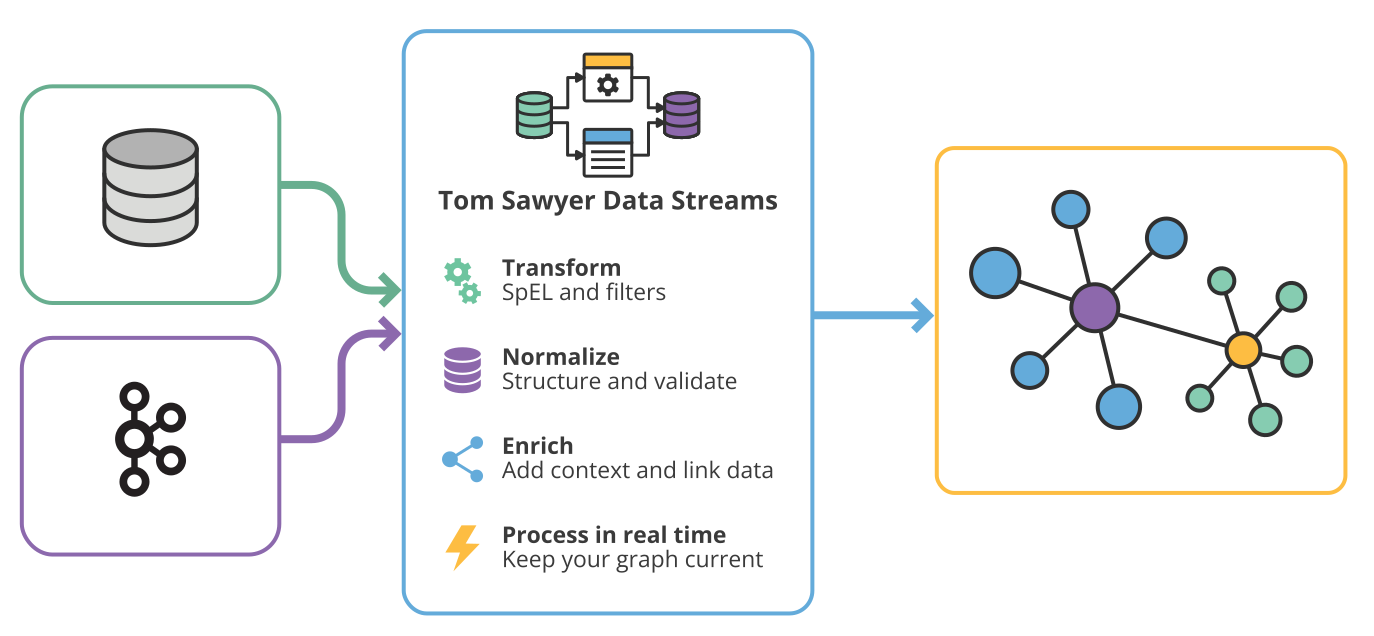
Tom Sawyer Data Streams integrates SQL databases and Kafka streaming sources to transform data into a structured knowledge graph.
Visually design and validate your data flows
Tom Sawyer Data Streams' intuitive web-based designer lets you visually assemble sources, transformations, conditions, and sinks to build and monitor data flows, accelerating development while reducing custom code.
The dynamic schema view displays input and output schemas helping you understand data structures and validate how data moves through a stream:
- View the input schema on sink, condition, and transformation nodes.
- View the output schema on condition, transformation, and source nodes in your data streams.
Automatic graph layout organizes complex pipelines for greater clarity, making it easier to identify dependencies, refine logic, and move from prototype to production with confidence.
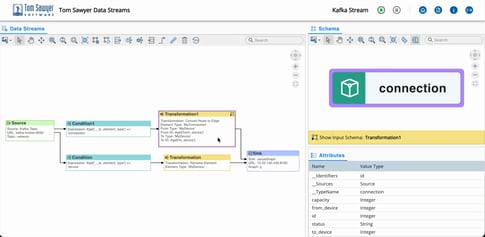
Tom Sawyer Data Streams visual data flow editor makes it easy to build and validate your data flow.
Effortlessly apply transformations to topics
Transformations turn raw stream events into a coherent, query-ready model. Incoming topics enter the flow as nodes; you then promote the right connections by converting selected nodes into edges and standardize naming to match your domain vocabulary. The result is a knowledge graph model that reflects how things actually relate, not just how they were recorded upstream.
For technical teams, this approach reduces custom ETL operations and enforces consistency without heavy refactoring. You define intent visually, validate the evolving structure against your schema, and keep semantics stable across sources. Expressions (SpEL) give you precise, lightweight control while keeping the overall flow simple to reason about and easy to review.
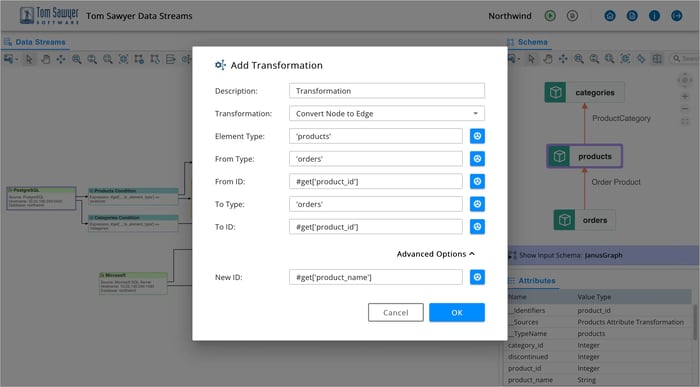
With Tom Sawyer Data Streams transformations, it's easy to build the knowledge graph model you wish you had.

Persist data in a graph database
Tom Sawyer Data Streams persists the model to a graph database for durability, sharing, and governance. The stored graph becomes a query-ready foundation for analytics, visualization, and AI, and is compatible with existing pipelines, catalogs, and security controls. Versionable schemas and clear provenance help teams evolve models safely while maintaining an authoritative, auditable source of truth.

Authenticate and control access
Tom Sawyer Data Streams supports authentication with OAuth 2.0 and Keycloak to support secure, multi-user environments. Align with enterprise standards for access and encryption while maintaining a clean, auditable boundary around sensitive data.
Tom Sawyer Data Streams supplies the structured, governed context that modern AI systems require. With your query-ready knowledge graph in place, AI teams gain a governed context layer for training, inference, and agent workflows.
The graph provides clean entities, explicit relationships, and provenance, which are ideal for AI feature engineering, retrieval/grounding, and constraint-aware prompts.
 |
Prepare and process data within AI pipelines: Normalize, enrich, and link events into structured entities and relationships suitable for feature stores, embeddings, and vector indexes. |
|
Support LLM (large language model) creation for improved accuracy: Provide graph-backed retrieval and grounding during training, fine-tuning, and RAG to reduce hallucinations and tighten answers. |
|
Validate generative AI results: Check outputs against authoritative nodes and edges, enforce policy constraints via graph rules, and trace impact through lineage for reproducible evaluation. |
|
Integrate agentic results into a single source of truth: Write agent plans, tool calls, and derived facts back into the governed graph to maintain a consolidated, provenance-rich record for ongoing learning and operations. |
Visualize your model with Tom Sawyer Software companion products
For added value, pair Tom Sawyer Data Streams with Tom Sawyer Software’s graph and data visualization and analysis products to explore, analyze, and communicate the value of the graph. Our best-in-class automatic graph layout quickly transforms complex connections into clean, easy-to-understand visualizations.
Tom Sawyer Explorations
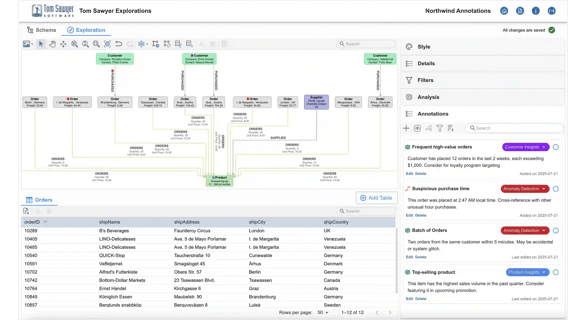
Explorations is a no-code graph intelligence application for analysts of all levels to connect to graph databases, build queries visually without query language expertise, and instantly explore the results as an interactive knowledge graph. With built-in graph analysis algorithms, users can uncover hidden patterns and gain deeper insights effortlessly.
Tom Sawyer Perspectives
Perspectives is a powerful, low-code development platform for building standalone applications or embedding advanced data analysis and visualization into existing systems. Use advanced layouts, styling, and UX components to build custom apps and dashboards on top of your graph model.
The benefits of Tom Sawyer Data Streams are clear
Tom Sawyer Data Streams helps teams break through data silos so they can see the full picture. It provides a practical path to build a usable knowledge graph from disparate systems and streams, and to turn that graph into real-time insight for operations and analysis.

Unified View of Critical Data
Consolidate relational, NoSQL, files, APIs, and event streams via Kafka into one consistent, query-ready model.

Faster Time to Insight
Visual flow design and expressive transformations reduce custom ETL work and shorten integration cycles.

Real-Time Processing
Execute flows continuously to normalize, enrich, and link events as they arrive for timely decisions.

Higher Data Quality and Consistency
Schema-driven mapping, validation, and filtering produce cleaner entities and relationships.

Context-Rich Analytics
Model relationships for impact analysis, lineage tracing, and root-cause investigation.

Governance and Auditability
Persist the graph to a graph database for shared access, versionable schemas, and clear provenance.

Ownership and Portability
Your model and data live in your database, ready for use with existing pipelines, tools, and policies.

Secure Integration
Works with your Kafka authentication and encryption settings.

Incremental Adoption
Start with a single migration or CDC flow and expand as value is proven across teams.