Tom Sawyer Intelligence Analysis brings data integration, graph visualization, and analysis together in a modular environment for intelligence organizations, defense and national security teams, and law enforcement agencies.
Connect information from databases, real-time streams, knowledge graphs, APIs, and other enterprise systems. Build connected views of people, organizations, accounts, assets, transactions, locations, devices, events, and other entities, then explore the relationships among them through interactive visualization and graph analysis.
Designed for both technical teams and analysts, the suite combines data integration and low-code application development with intuitive no-code investigation tools. Organizations can select the modules they need and expand the suite as their data sources, users, and investigative requirements evolve.
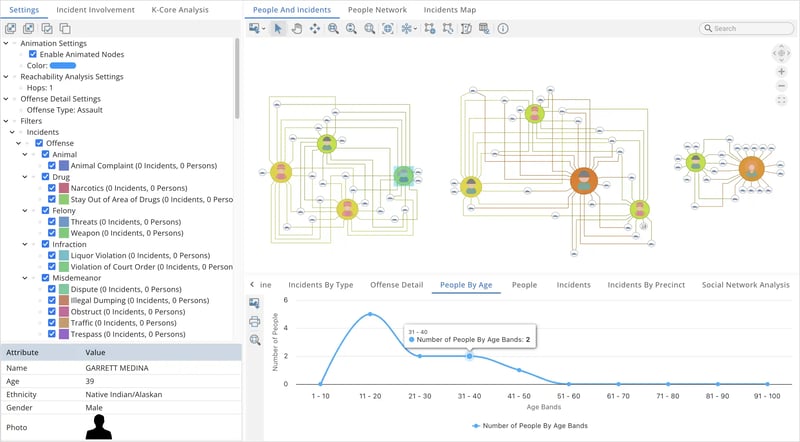
Tom Sawyer Intelligence Analysis reveals connections among people, businesses, and assets in a crime network to help analysts investigate cases and communicate key findings.
Trusted by government and industry leaders


Integrate data from disparate sources
Bring together information from relational databases, graph databases, real-time streams, REST APIs, RDF sources, JSON, and other enterprise systems.
Different integration approaches can be used depending on the source and investigative requirements. Data can be transformed into a persistent knowledge graph, federated from existing systems, or combined across multiple sources without requiring anything to be migrated into a single repository.
This flexibility helps organizations work with existing infrastructure while giving analysts a more complete view of the information relevant to an investigation.
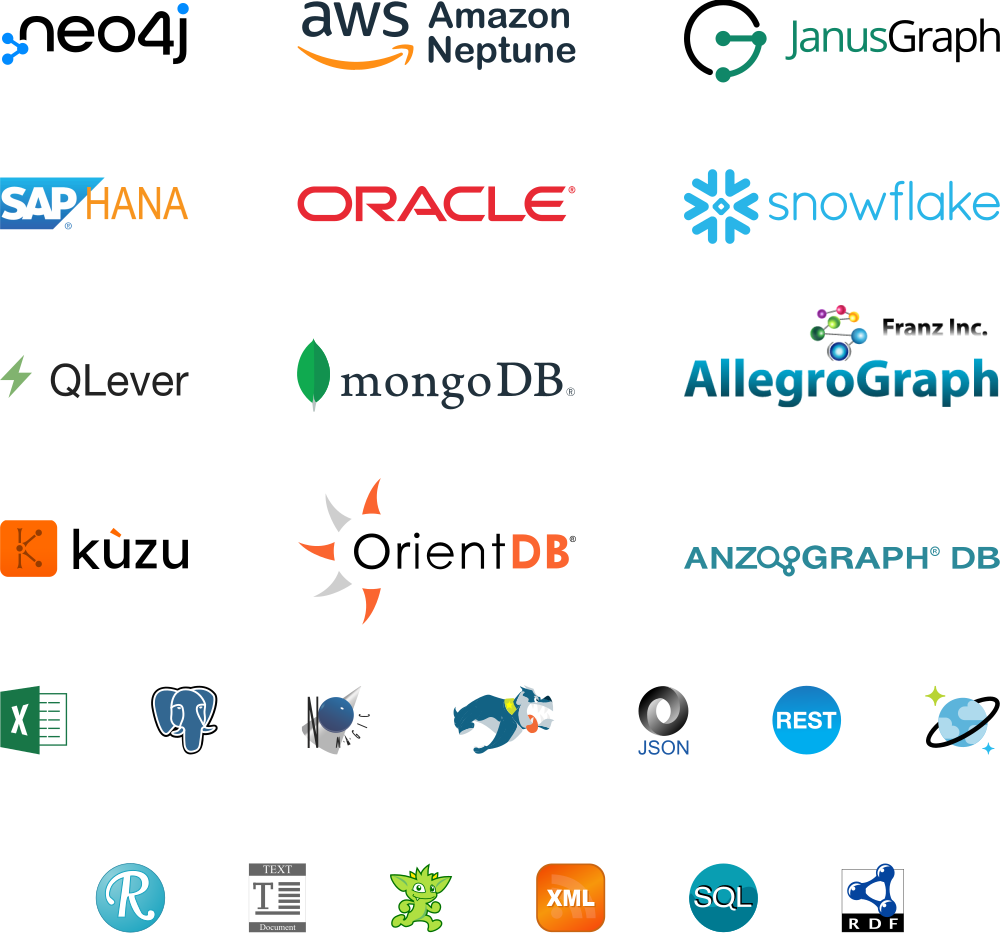
Federate and integrate data from dozens of sources including graph databases, relational databases, JSON, RDF, CSV, and more.
Build unified graph models
Transform records from different systems into a unified graph model that represents the entities and relationships important to your mission. A graph model can connect information about people, organizations, accounts, transactions, assets, locations, devices, communications, events, cases, and other entities, even when those records originate in different systems.
By representing information according to its relationships rather than its original source structure, analysts can work with connected information instead of isolated records.
This flexibility helps organizations work with existing infrastructure while giving analysts a more complete view of the information relevant to an investigation.
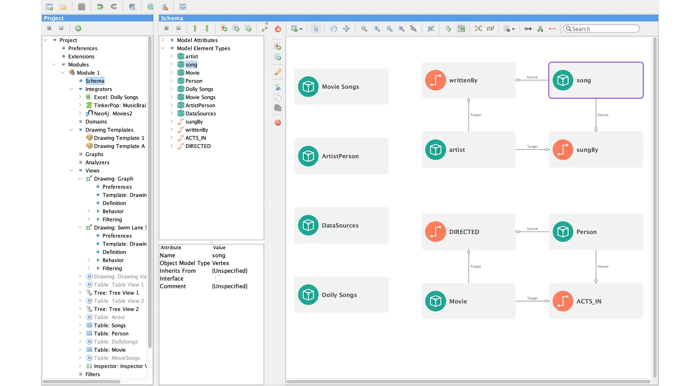
Analyze complex, high-volume data
Large investigations can contain thousands or millions of entities and relationships.
Tom Sawyer Intelligence Analysis provides visualization, navigation, filtering, pattern matching, and graph analysis capabilities designed to help analysts work with large, complex networks without losing context.
Users can focus on relevant portions of the data, investigate connections incrementally, and apply analysis techniques that help identify relationships, structures, and entities that warrant further examination.
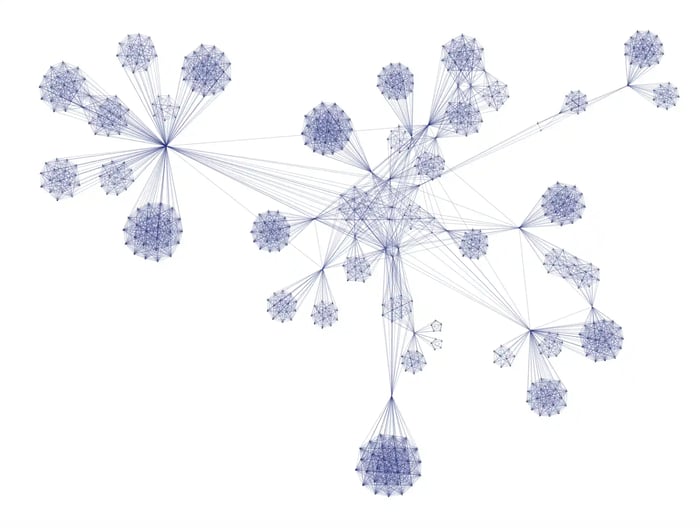
Tom Sawyer Intelligence Analysis can visualize large networks and help identify relationships and structures.
See how FBI N-DEx enhances law enforcement investigations with Tom Sawyer Perspectives
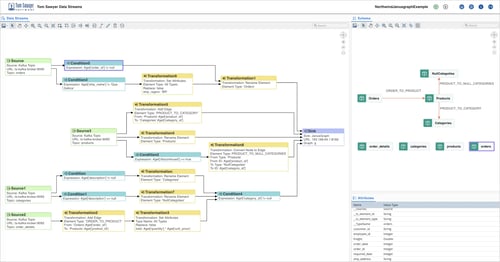
Tom Sawyer Data Streams for data integration
Tom Sawyer Data Streams provides the data integration foundation for building and maintaining knowledge graphs from operational data. Integrate data from SQL databases and Apache Kafka streams, transform and normalize records, define relationships, and persist the resulting information as a connected graph. Visual data flows make it easier to understand how information moves from source systems into the graph and how transformations are applied along the way.
Tom Sawyer Data Streams can help organizations:
- Integrate SQL database data and real-time streams.
- Transform disparate records into a consistent graph model.
- Define relationships across source systems.
- Continuously update graph data as underlying information changes.
- Reduce custom development required for data integration.
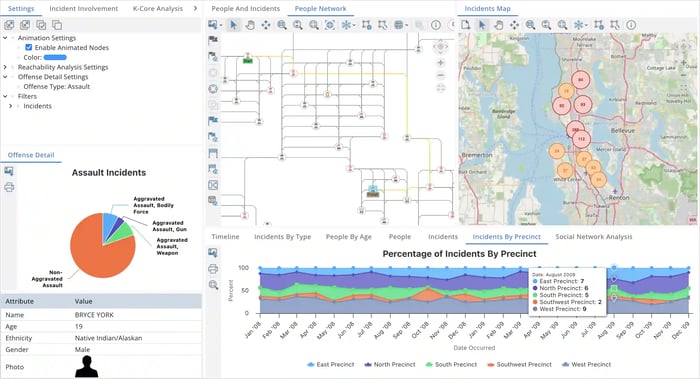
Tom Sawyer Perspectives for intelligence application development
Tom Sawyer Perspectives is a low-code application development platform for building specialized intelligence analysis applications and investigative workflows. Tom Sawyer Perspectives federates information from relational databases, graph databases, RDF, REST APIs, JSON, and other enterprise sources. Development teams can create applications that combine those sources within a common application without requiring all information to be moved into a single database. Applications can be customized to incorporate interactive graph drawings, tables, maps, timelines, charts, inspector views, annotations, search, filtering, and graph analysis.
Tom Sawyer Perspectives can help development teams:
- Integrate information across existing enterprise systems.
- Build common graph models across multiple data sources.
- Develop specialized intelligence and investigative applications.
- Apply business rules, filters, analytics, and custom logic.
- Tailor user interfaces and workflows to specific missions and users.
Tom Sawyer Explorations for interactive, no-code graph analysis
Tom Sawyer Explorations provides a no-code environment for analysts who need to explore and investigate connected information directly. Users can search graph data, construct visual pattern-matching queries, follow relationships, analyze results, and apply graph algorithms without writing code or learning a database query language.
Tom Sawyer Explorations can help analysts:
- Search and explore connected data visually.
- Follow relationships through complex networks.
- Construct graph pattern-matching queries without code.
- Apply graph analysis algorithms to investigation results.
- Navigate large networks while maintaining context.
- Begin working with graph data with minimal technical training.
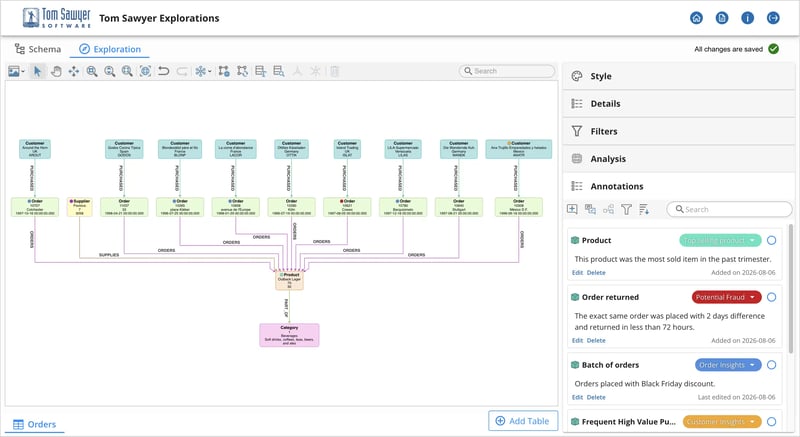
Visualize entities and relationships
Represent information as interactive networks of entities and relationships rather than isolated rows and records. Graph visualization can help analysts quickly understand how entities are connected, recognize clusters and structures, and maintain context as an investigation expands.
Customize graph drawings with swimlanes, and combine graph drawings with tables, maps, timelines, charts, and inspector views to examine information from different perspectives.
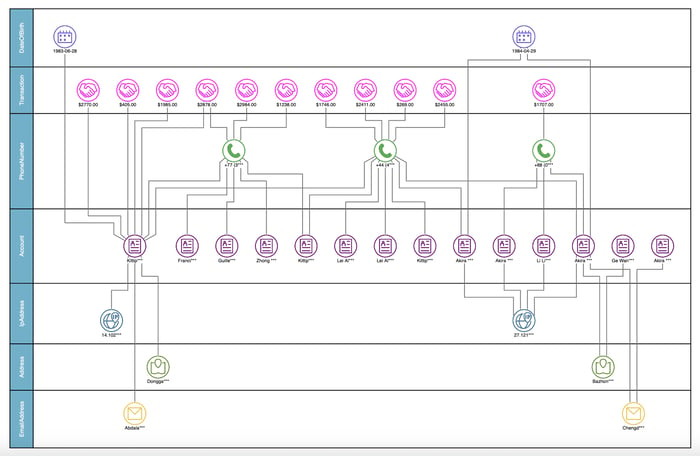
A graph visualization of suspected fraudulent activity shown in a swimlane view by element type.
Explore direct and indirect connections
Not every important relationship is direct. Analysts can follow paths across multiple entities to investigate how seemingly unrelated people, organizations, transactions, accounts, devices, locations, or events are connected.
Interactive expansion, filtering, navigation, and search help users move through large networks incrementally and focus on relationships relevant to the current investigation.
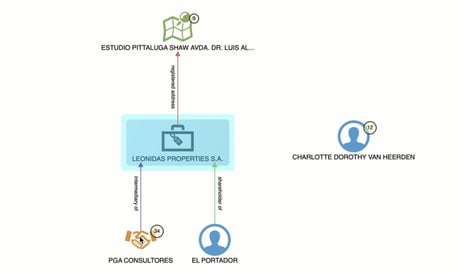
Incrementally load data in any direction to support your investigation.
Apply advanced graph analysis
Advanced graph analysis identifies structural patterns that may be difficult to recognize visually. Depending on the application and workflow, analysts can use graph analysis techniques such as:
- Centrality analysis
- Connectivity analysis
- Clustering
- Path analysis
- Network structure analysis
- Pattern matching
These capabilities help identify influential entities, intermediaries, groups, connections, and other network characteristics that may warrant additional investigation.
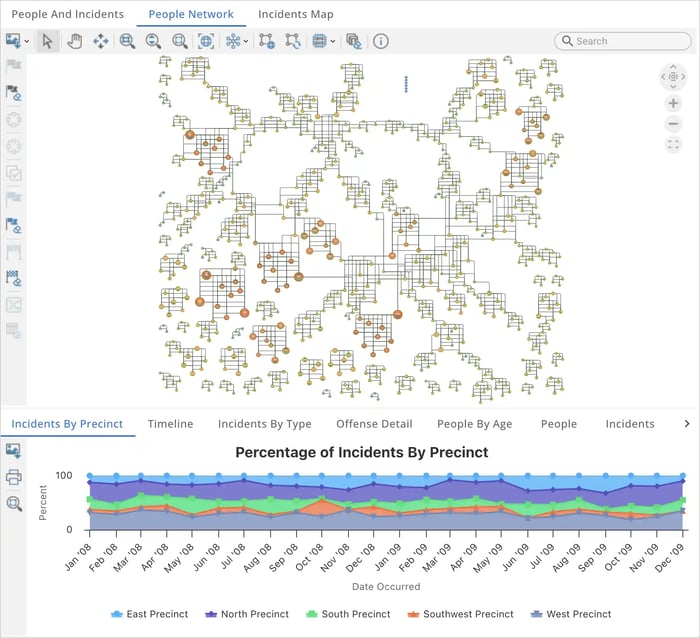
A graph visualization of a criminal network showing middlemen and influencers of the network as larger nodes.
Support mission-focused intelligence workflows
Different investigative missions require different data, workflows, and analytical techniques.
Tom Sawyer Intelligence Analysis provides a flexible foundation that organizations can configure around specific operational requirements while using common connected-data and graph-analysis capabilities.
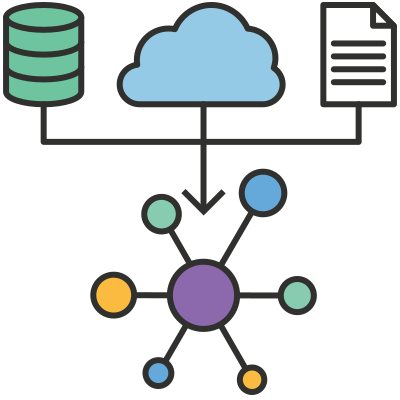
Multi-source intelligence investigations
Connect information from multiple systems to investigate entities, relationships, activities, and events across fragmented data sources.
Analysts can move across connected information without having to examine each source independently, helping them develop a more complete view of a subject, event, organization, or network.
Threat discovery and network analysis
Explore relationships among people, organizations, infrastructure, communications, assets, events, and other entities involved in complex threat networks.
Use visualization and network analysis to identify important entities, intermediaries, groups, and patterns that may not be apparent from individual records.
Fraud detection and analysis
Connect accounts, transactions, businesses, individuals, devices, locations, and other entities to investigate potentially suspicious relationships and activity.
Graph analysis can help analysts identify shared attributes, indirect connections, unusual network structures, recurring patterns, and relationships that may indicate coordinated fraud.
Tom Sawyer Intelligence Analysis can support fraud detection and investigative workflows in financial services, insurance, government programs, and other environments where relationships among entities are important.
Mission-critical decision support
Analysts often need to communicate complex findings to operational leaders and decision makers.
Interactive visualization helps organize connected information and present important relationships in a form that is easier to understand.
By combining underlying data with visual context, analysis, and supporting views, teams can communicate investigative findings more clearly and support mission-critical decision-making.
Configure the suite around your requirements
Tom Sawyer Intelligence Analysis is designed to support incremental deployment, integration with existing systems, and multiple deployment architectures so organizations can adopt the capabilities they need utilizing their existing infrastructure.
Select the components you need
Choose the modules that match your current requirements.
An organization may begin with analyst-driven graph exploration, deploy data integration first, build a customized intelligence application, or combine all three modules as part of a broader solution.
Additional capabilities can be added as the number of users, data sources, and investigative workflows grows.
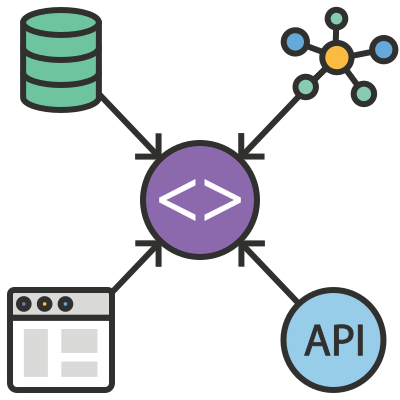
Integrate with existing data and systems
Work with existing databases, applications, APIs, and enterprise infrastructure rather than requiring all data to be moved into a proprietary platform.
The suite supports multiple integration approaches so organizations can determine which information should be federated, streamed, transformed, or persisted in a knowledge graph.
This open approach gives organizations greater control over their data architecture and helps reduce dependence on any single database technology.

Deploy in your preferred environment
Deploy Tom Sawyer Intelligence Analysis according to your organization's infrastructure and security requirements.
Depending on the selected components and application architecture, Tom Sawyer Software technologies can support on-premises, cloud-based, containerized, and other enterprise deployment environments.
Deployment can be designed around existing security, data governance, scalability, and operational requirements.